Why Out-of-Hours Floor Work Matters for London Businesses
Running a commercial space in London means every hour of downtime costs money. I have seen it time and again: a restaurant in Soho that needs its oak floor sanded but cannot close for a full day, or a hotel in Kensington that wants parquet sanding done without guests tripping over equipment. The solution is out-of-hours floor work, and it is more than a convenience. It is often the only practical way to keep a business running while the floors get the attention they deserve.
Out-of-hours floor work is not a new concept, but it has become more refined over the years. When I started in this trade, working evenings or weekends meant dragging heavy sanders into a dark building and hoping the noise did not disturb the neighbours. Today, with better equipment and planning, it is a standard offering from any serious floor repair specialist. The key is matching the right approach to the specific floor and the specific schedule of the client.
Understanding the Need for After-Hours Work
Retail shops, offices, and hospitality venues all have one thing in common: they operate during the day. A wood floor restoration project that takes three days would shut down a shop for three trading days. That is lost revenue, frustrated customers, and a logistical headache. By doing the work after closing time or over the weekend, the disruption drops to almost zero. The floor gets sanded, sealed, and finished while the business is quiet, and by Monday morning everything is dry and ready for foot traffic.
There is also the matter of dust and odour. Even with dust-free sanding systems, some fine particles can settle on surfaces. Doing the work out of hours gives the cleaning team a chance to wipe everything down before the doors open. And if floor varnish or floor sealing products are used, the fumes have time to clear overnight. For a restaurant or a care home, that is non-negotiable.

Practical Considerations for Different Floor Types
Not every floor handles out-of-hours work the same way. An engineered wood floor, for example, is more sensitive to humidity and temperature changes. If the heating goes off overnight in a London office, the floor can contract slightly, and sanding it cold can create a poor finish. A good contractor will check the building's climate control before starting, and may adjust the schedule accordingly. Hardwood floor restoration on a solid oak floor is more forgiving, but still requires the room to be at a stable temperature for the varnish to cure properly.
Herringbone floor patterns add another layer of complexity. The direction of the grain changes with each strip, so sanding must be done with care to avoid cross-grain scratches. Out-of-hours floor work on a herringbone floor often takes longer per square metre than a straight-lay board, because the sander has to be moved in different directions and the edges need hand-finishing. But the result is worth it: a smooth, even surface that shows off the pattern.
Noise and Neighbours
One of the biggest challenges of out-of-hours floor work is noise. A floor sander running at full power can be heard through walls and floors. In a mixed-use London building, where offices sit above shops and flats sit above offices, that noise can cause complaints. I have learned to always check the building's lease terms and talk to neighbours before starting. Some commercial leases have clauses about noise after 6 pm, and residential tenants have rights to quiet enjoyment.
The solution is a combination of good planning and the right tools. Modern sanders from Lagler, for instance, are quieter than older models, and using Norton Abrasives with the correct grit sequence reduces the time the machine needs to run. Dust-free sanding also helps, because it means the work area can be sealed off with plastic sheeting and the machine's vacuum system keeps dust from spreading. Even so, I always recommend finishing the loudest passes early in the evening and leaving the quieter tasks, like hand-sanding edges or applying floor sealing, for later.
Commercial Floor Maintenance and Restoration
Commercial floor maintenance is not the same as residential floor care. The traffic is heavier, the dirt is more abrasive, and the schedule is tighter. A hotel lobby might see thousands of footsteps a day, each one grinding grit into the finish. Over time, the floor varnish wears thin and the wood underneath starts to show wear. A full restoration, including wood floor sanding and re-sealing, can bring it back to life. But doing that during peak hours is impossible. That is where out-of-hours floor work becomes essential.
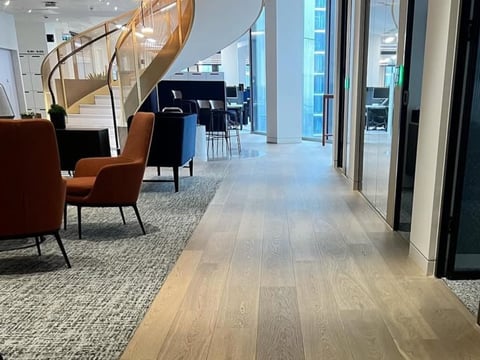
I have done many such projects in central London, from old Victorian parquet in a Mayfair townhouse to modern engineered wood in a Canary Wharf office. The approach is always the same: assess the floor, agree a schedule that suits the client, and carry out the work in phases if needed. For a large open-plan office, we might do one half of the floor over a weekend, let it cure during the week, and do the other half the following weekend. The client never has to close completely.
Products and Tools That Make It Work
Using the right products is critical when working out of hours. Bona floor finishes, for example, are water-based and low-odour, so they can be applied indoors without creating a strong smell that lingers. They also dry faster than solvent-based alternatives, which means the floor can be walked on sooner. For high-traffic commercial flooring, I often recommend a two-coat system: a sealer followed by a hard-wearing varnish. The sealer soaks into the wood and locks it, while the varnish provides the surface durability.
Tools matter too. A good sander from Lagler or a reliable edge sander from Norton Abrasives can make the difference between a job that finishes on time and one that runs into the next day. Dust-free sanding is not just about cleanliness; it also helps the operator work faster because they are not stopping to clean up. And for parquet sanding, a multi-disc sander is far more efficient than a belt sander, because it removes material evenly across the grain.
Is Out-of-Hours Floor Work More Expensive?
This is the question every client asks. The honest answer is that it can be, but it depends. If the contractor has to pay overtime to their staff, or if the building's management charges for after-hours access, those costs will be passed on. On the other hand, if the work is planned in advance and the contractor can fit it into their normal schedule without overtime, the price may be the same as a daytime job. The extra cost, if there is one, is usually small compared to the cost of closing a business for a day.
I have seen clients save money in the long run by choosing out-of-hours floor work. A restaurant that closes for a floor restoration loses a day's takings. If the out-of-hours premium is a few hundred pounds but the day's revenue is a few thousand, the maths is clear. The same logic applies to shops, offices, and hotels. The floor restoration services might cost a little more, but the business keeps trading, and that makes it worthwhile.

Final Thoughts
Out-of-hours floor work is a practical solution for London businesses that cannot afford downtime. It requires careful planning, the right equipment, and a contractor who understands the quirks of different floor types. But when done well, it delivers a restored floor with minimal disruption. Whether it is a herringbone floor in a boutique hotel or a straight-lay oak floor in a law firm, the principle is the same: do the work when the space is empty, and let the business run as usual.
For anyone considering a floor restoration, my advice is to talk to your contractor about scheduling early. Ask about their experience with out-of-hours floor work, what equipment they use, and how they handle noise and dust. A good contractor will be upfront about the challenges and will work with you to find a plan that fits your business. The result is a floor that looks great and lasts, without ever shutting your doors.